
You've already adopted agentic AI. You just didn't decide to.
Oct 7 2026 - By Alliance
By the MACH Alliance Agent Adoption & Operations Working Group
The first piece in a three-part series, and an invitation to help write the rest.
The question
Try this at your next leadership meeting. Ask how many AI agents are running in the business right now. Not planned, not in a pilot. Running.
Then watch the room. The CTO gives a number, probably for engineering. The CFO asks what you mean by "agent." Someone from marketing mentions a tool nobody else has heard of. Nobody can answer for the whole organization, and most people can't answer for their own function.
That is new. Technology used to come in through the front door. A rollout had a business case, a budget, a procurement process, an inventory, and a named owner who got the call when it broke. In 2026, agentic AI still comes through that door. It also comes through a hundred side doors at once, and nobody decided to open most of them.
Is that a problem? We think it's both the best and the most uncomfortable thing happening in enterprise technology right now.
That question — how long it would take you to list every agent, with a named owner for each — is question three of a three-minute survey we're running. Answer it now, or read on and answer it better.
Where the agents came from
To make the question answerable, we group agents by where they come from. Four sources, ordered from most to least visible to leadership.
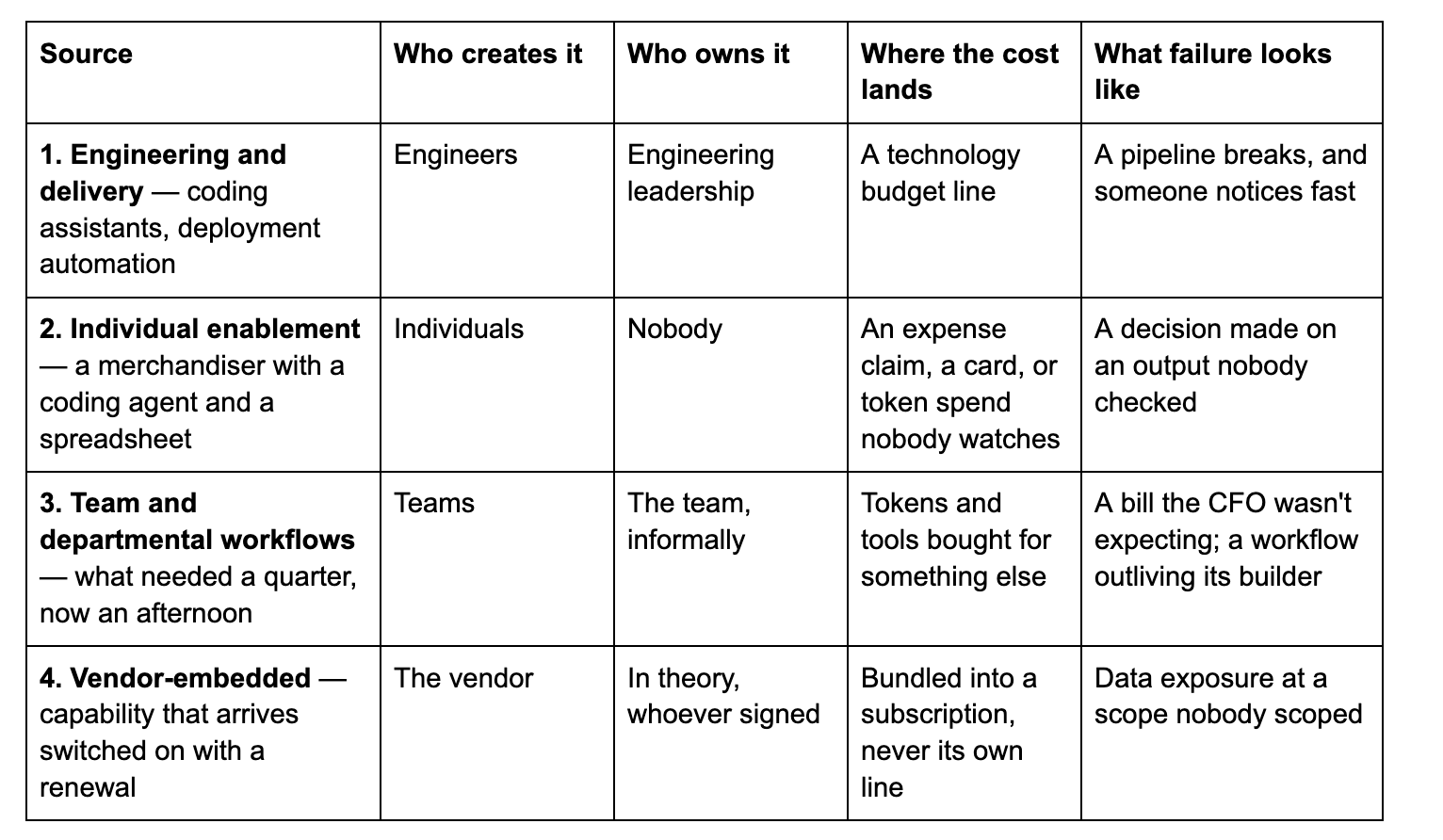
Source 1 is what most leaders picture when they say "our AI strategy," and it's the only one of the four we've had time to get good at measuring.
Source 4 is the one worth sitting with. Take a CRM your teams have used for a decade. Nobody asked for the agent inside it. It shipped because every large vendor is racing to be agentic, and it does something reasonable: it answers questions across data already in the system. But it is far better at joining those records than the report builders it sits next to, so people start getting answers they were entitled to request and had never once been able to assemble. No new permission was granted. None was needed. The decision behind it was a signature on a renewal.
None of which makes embedded agents a bad deal. For an organization with no internal capability, they are the fastest route to value there is. The problem isn't the agent. It's that nobody registered its arrival.
Notice the pattern. The source we understand best has the clearest ownership, and it may already be the smallest share of what's actually running.
If this feels familiar, it should. SaaS brought shadow IT, and no-code brought the citizen developer. But no-code had a ceiling: sooner or later you needed the tech team for an integration or for data access. Agents removed that ceiling. People outside technology can now write code, reach data, connect systems and push to production without asking anyone. Not evenly, though — agents reach the SaaS layer far more easily than the ERP, so sprawl concentrates where the APIs are cleanest and data governance is thinnest. And that velocity is a good thing. Or is it?
Why this is working
Read that as a warning if you like. We don't, or not entirely.
No transformation program. No central bottleneck. The people who understand the problem are building the capability themselves, instead of writing requirements for someone who will build it two quarters later. Learning happens in the business rather than in a pilot committee, and teams are finding capacity, sometimes revenue, in places nobody had staffed to look.
That matters because most AI work still hasn't left the experiment. McKinsey's global survey this year, fielded in May and June across 1,719 respondents, found 80 percent of people saying AI had improved their own productivity, against 37 percent attributing any EBIT contribution to it — essentially unchanged from a year earlier (The state of AI in 2026). The value is arriving on individuals. It isn't arriving in the accounts.
Three real gains sit underneath all of that: innovation that doesn't wait for sign-off, teams optimizing their own work, and the people closest to a problem owning the solution to it. Hold on to those three.
Both are true
Both of those sections are true at once. Every tension here is between two things organizations want.
What distributed adoption gives you | What centralized control gives you |
|---|---|
An answer this afternoon | An answer the organization agrees with |
Built by whoever saw the problem | Owned by someone after they leave |
Spend that follows the work | Spend approved before the work |
Data reached at the speed of the question | Access decided before it's granted |
Experiments nobody had to register | A record of everything that ran |
In the old world, organizations got the right-hand column by default. Technology was centralized, so control came built in, and innovation paid for it. Today the default has flipped to the left. Neither of those was a decision anyone made.
So the question isn't which column is right. It's whether your position on each row is one you chose, or one that Sources 2, 3 and 4 settled for you while leadership was watching Source 1.
Why it stops working
What makes decentralized adoption fast also makes it fragile. Four places where it breaks.
Cost with no owner. Autonomous agents consume far more than one-off queries, and with usage-based pricing the bill arrives after the decision. One in five organizations in that same survey said operating costs were already constraining their use of AI.
Inconsistent answers. Two agents built by different teams, over different systems, can answer the same question differently, and both answers will be defensible. Neither may match what your organization would call correct. A better model won't fix that. It's a question of whether anyone has agreed what the data means.
Exposure. Vendor agents extend what people can access or trigger without anyone deciding they should. Nobody granted the access. It came with the upgrade.
Nothing to audit. In Sources 2 to 4 there's often no record of what ran, on what data, or on whose authority — and the stakes aren't uniform. A workflow touching revenue recognition is a different conversation from one that reformats a deck.
Nobody has the data
Choosing deliberately takes evidence, and there isn't much. Source 1 is the exception: engineering has been measuring its own adoption of new tooling for years. Sources 2 to 4 have none of that, because they didn't exist at this scale eighteen months ago. Anyone publishing confident benchmarks right now is extrapolating.
What's missing is both sides of the ledger: the value created by agents built outside IT, and the cost of the risks that come with them. Without both, there's no serious conversation about risk-adjusted return — what the value is worth once you've priced what can go wrong — which is where this series is heading. And notice which half of that ledger we could source. The absence of enterprise-level return is documented. The value being created outside IT isn't documented at all.
So we're not going to extrapolate. We're going to ask.
The question you should be asking
Start with the one most leaders skip: who would you hand each of the four sources to? Not who uses them. Who answers for them. Source 1 has an answer at most companies. Sources 2 and 4 rarely have one at all. Write four names down. If you can't, you've found the work, and it isn't a governance framework. It's four conversations.
If four names are hard to come by, notice where they come easily. The parts of the business that can name the owner of an integration are usually the parts that can name the owner of an agent using it. Decomposing monoliths left some organizations with a service catalog and ownership that survives a reorg, and that turns out to be what an agent inventory runs on. Whether it holds at scale is one of the things the survey asks.
Then two more, source by source:
- If your CEO asked today for a list of every agent running, with a named owner for each, how long would it take?
- What counts as an agent here? One of us put this to colleagues at their own company. The CFO and the CTO gave answers that didn't overlap, and neither matched how OpenAI or Anthropic define the term. Where would your organization draw the line, and does anyone know it has?
The survey and the series
We started this working group trying to answer a bigger question: what's the return on AI investment? We couldn't, because we couldn't agree on the basics. What is an agent? Where do they come from? What's actually running? So we're starting there, in the open.
Take the survey. Three minutes, and everyone who completes it gets the full aggregated results back, so you can put your answers next to your peers' rather than guessing. We'll publish what comes back, even if it's messy, and whether or not it supports our hypothesis. If you're at MACH X in Amsterdam, come and find us.
Next in the series: what agents really cost and how to measure their return, then how organizations are taking control of what's already running — including where the evidence of it already sits in systems you own.
As MACH moves from composable technology to composable AI, the organizations that get this right won't be the ones with the most agents. They'll be the ones that know what they have, and can say who answers for it.