
The Path to Transformation: A focus on Interoperability
Dec 19 2024 - By Member
Author: Adam Peter Nielsen - Co-Lead Technology Council, MACH Alliance & CTO, Novicell
The Path to Transformation: A focus on Interoperability
As a follow up to my previous blog "Interoperate to Iterate Faster" where I discussed why interoperability is now a strategic business concern, it is also important to understand what it takes to ensure an organization’s technology stack is truly interoperable.
To address the challenges, I outlined such as outdated legacy systems, the need for speed and agility, and the Generative AI opportunity, organizations must prioritize making their technology stack truly interoperable.
So, what does that take?
The focus should shift from the individual components to how these components interact and work together to create a cohesive ecosystem. Here’s what that transformation path looks like:
Step 1: Evaluate your tech stack
Identify integration bottlenecks and prioritize platforms that enable composability and interoperability. In the whitepaper below, organizations can learn how to evaluate and integrate composable solutions (and what to do when you have elements that don't conform).

Modern data orchestration services make it easier to synchronize data across systems, and configure data flows rather than programming them, thus accelerating AI implementation and other innovations.
Step 3: Build for Flexibility
Adopt MACH (Microservices, API-first, Cloud-native, and Headless) and composable architectures to ensure your stack can evolve with your business needs.
The Role of Technology Solutions
Interoperability is particularly critical in headless and composable architectures.
To succeed, the "head" (user-facing components) and "body" (back-end systems) must communicate seamlessly. Here’s how modern interoperability solutions drive value:
- Ease of Integration: Interoperable platforms allow businesses to adopt best-of-need solutions without worrying about compatibility.
- Reduced Vendor Lock-in: Interoperability ensures businesses can retire underperforming platforms without incurring financial or operational penalties.
- Faster ROI: A well-integrated stack accelerates deployment and delivers measurable outcomes, such as increased revenue or reduced costs, sooner.
Key Benefits and KPIs
Interoperability is a composable, multifaceted approach that drives measurable benefits, including:
- Increased innovation capacity: Free up IT teams to focus on strategic projects rather than troubleshooting integrations.
- Improved business agility: At the organizational level, teams can better collaborate and pivot quickly in response to market changes or new opportunities.
- Faster time to market: Accelerate the launch of new initiatives with seamless integrations.
KPIs to measure success include:
- Time-to-market for new solutions
- Number of systems seamlessly integrated
- ROI on technology investments
(hint: If you're interested in learning more about ROI and TCO, check out the new rideMACH expansion course 'Introduction to TCO' which explores best practices around interoperability and the cost efficiencies of a MACH approach)
Addressing Diverse Journeys: Starting Out vs. Scaling Up
- If you're just starting:
- Begin by assessing your current stack for interoperability gaps. Prioritize tools and platforms that are API-first and align with MACH principles.
- Look for what components in your stack to change or decommission next. Timing and lifecycle changes of platforms are often the best lever for building the case for where to start. -
If you're scaling:
- Focus on refining your data orchestration layers. These layers ensure that as your systems grow, they remain interconnected, enabling faster adoption of innovations like generative AI.
Why Interoperability matters to leaders
- For technology leaders:
Interoperability means freedom - the ability to build a best-in-class tech stack that grows alongside your business. -
For business leaders:
It translates to agility: the capacity to respond quickly to change and seize opportunities like generative AI, new markets, or to safely navigate a merger.
Combine to adapt and thrive at the right pace.
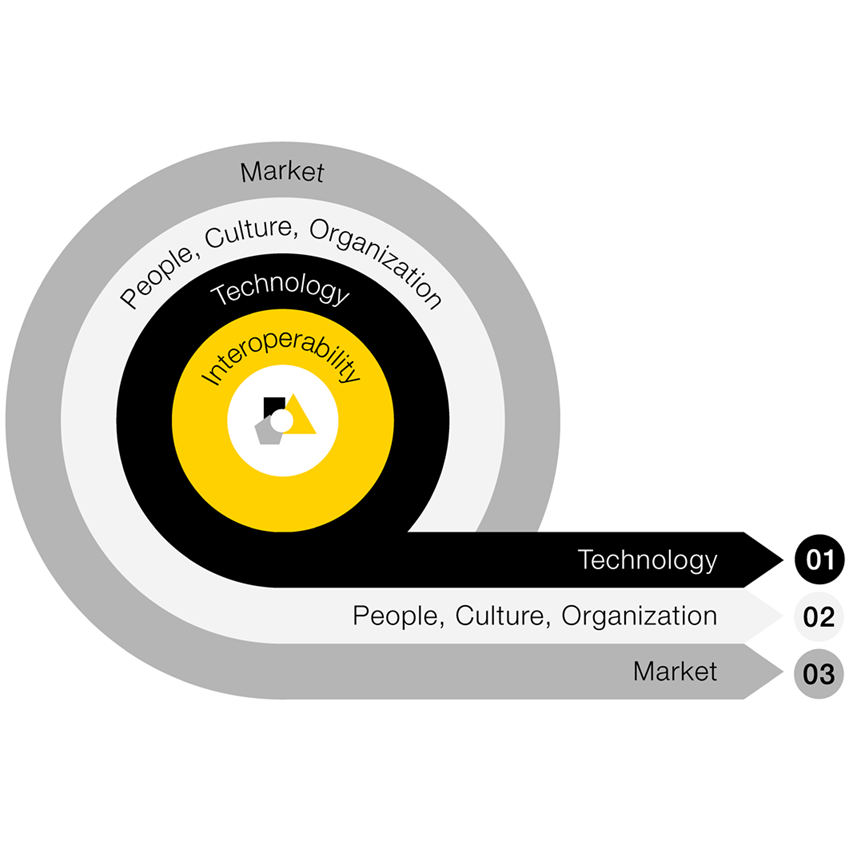
Interoperability Across the Dimensions of the Interoperability Wheel
- Technology:
Interoperability fosters technical freedom, ensuring that platforms integrate seamlessly and evolve with new innovations. -
People, Culture, Organization:
By enabling seamless workflows, interoperability creates a culture of innovation, where teams can experiment confidently and deliver better results.
-
Market:
Businesses with interoperable systems are better equipped to respond to market demands, outperform competitors, and build customer trust.
The actionable takeaways:
To thrive in 2025 and beyond, organizations must:
- Prioritize and validate ease of interoperability in all technology and vendor selections.
- Adopt MACH and composable architectures to ensure flexibility.
- Leverage data orchestration layers to power AI and other innovations.
- Ask the right questions: Is this solution interoperable? How will it integrate with your existing ecosystem?
My Final Word:
As I said in my first blog: Stop overthinking and focus on readiness!
Making composable architecture and interoperability work for your organization isn’t just about adding new tech—it’s about really looking at your entire tech stack and making sure everything connects and works together smoothly.
Whether you’re just getting started or already scaling up, it’s key to step back and see how your tools, data, and systems are syncing to drive real results. Using data integration and orchestration platforms can help make sure your data flows effortlessly across digital teams and platforms, so everyone has the data they need when and where they need it.
And as your business grows, asking the right questions about scalability, flexibility, and long-term goals will help you build an adaptable, connected system that grows with you. You will change systems and platforms over time, so prepare for a smooth technology transition by focusing on interoperability.
Get ready to tackle whatever the fast-changing digital throws your way.
Ready to learn more? Visit the MACH Alliance Interoperability Hub
.png)
- Interoperate to iterate faster in 2025.
Keywords: interoperability in digital architecture; MACH interoperability; interoperability in technology; MACH principles and interoperability;