
From Who Showed Up to What They Built: What a Recent Agentic Commerce Hackathon Revealed
Jul 9 2026 - By Member
By Andrew Kumar, Head of Loomi Connect, Bloomreach
Going into a recent agentic commerce hackathon, I had a simple hypothesis: there was clear curiosity around AI agents. What I did not know was how broad, motivated, and practical the builder audience would be.
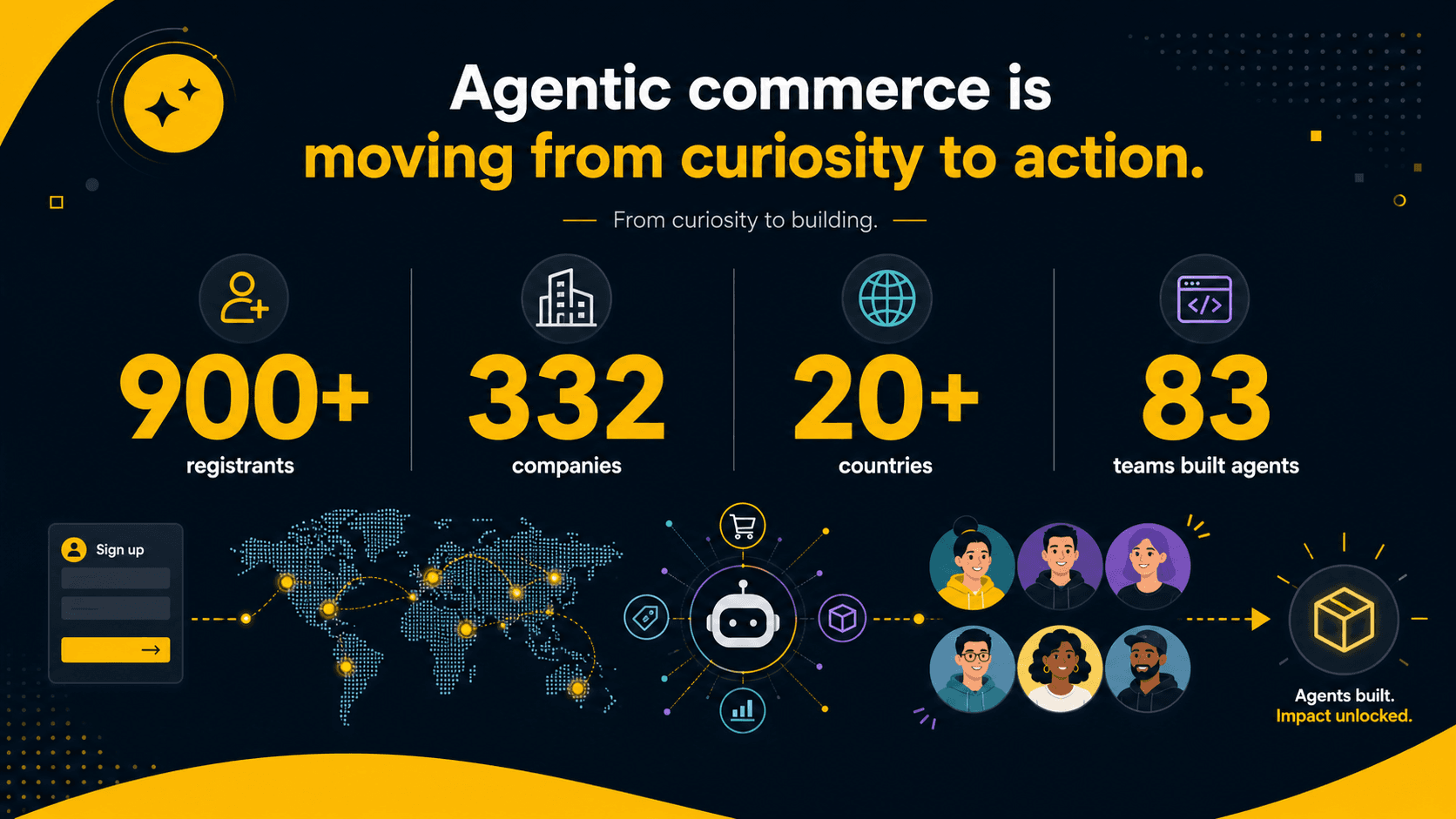
More than 900 people registered, representing 332 companies across more than 20 countries. In the end, 83 teams came together to build working agents. But the most interesting signal was not volume alone. It was who showed up, what they chose to build, and what that suggests about where agentic commerce is heading.
Taken together, those signals point to something bigger than hackathon enthusiasm. The market for agentic AI in commerce already appears broader than many assume, and the most promising builders are not chasing novelty. They are focused on practical business outcomes.
The audience was broader than expected
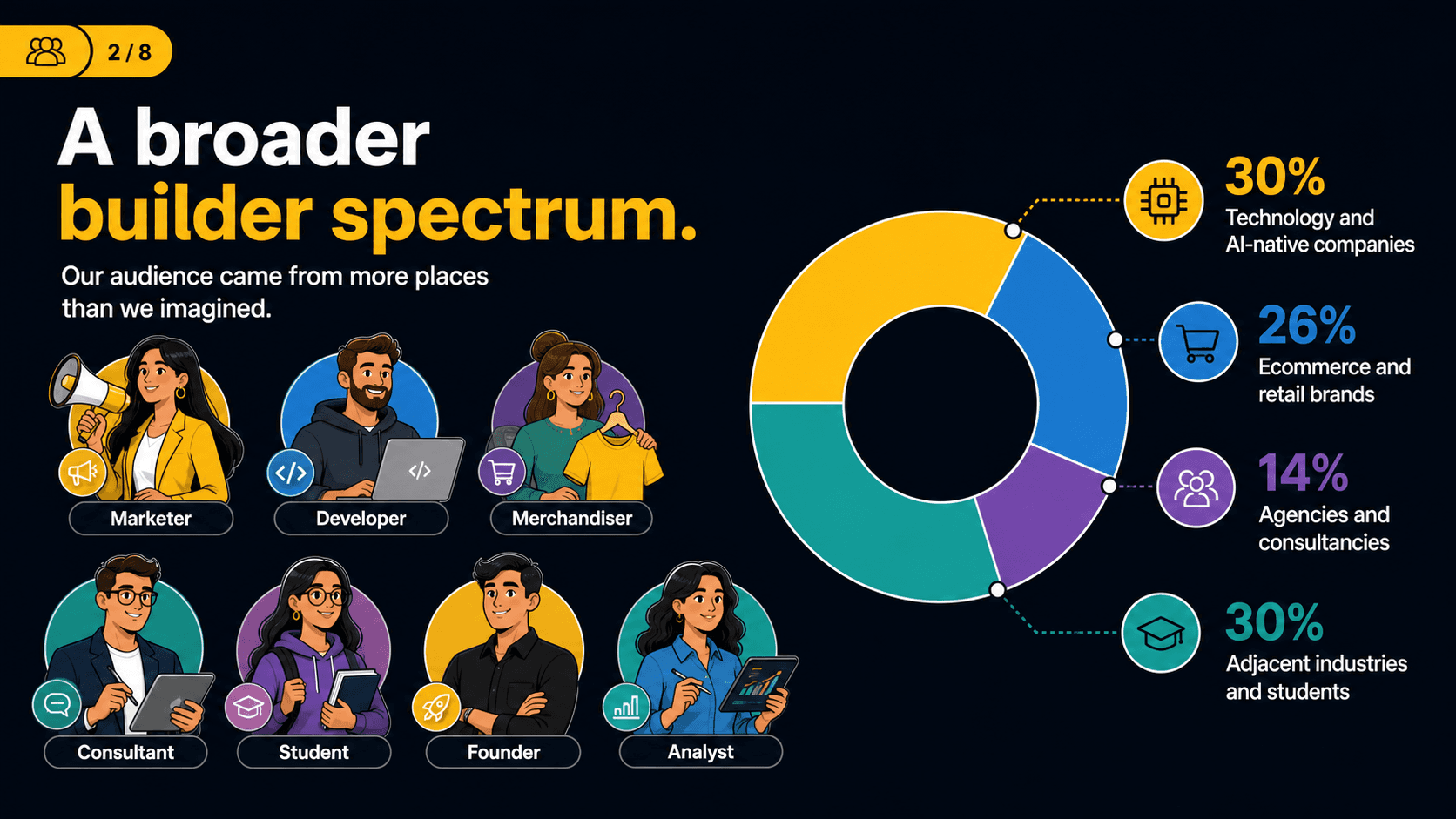
When people imagine who builds agents, they often default to software engineers or AI-native startups. That cohort was well represented. Roughly 30% of registrants came from technology and AI-native companies, including enterprise technology firms, infrastructure providers, and startups working close to the frontier.
But that was only part of the story.
Another 26% of participants came from ecommerce and retail brands: marketers, merchandisers, CRM specialists, and data teams who live inside commerce workflows every day. These are the people who understand operational friction firsthand, and they showed up ready to solve it.
There was also strong participation from agencies and consultancies, which made up 14% of registrants. In several cases, agencies did not send one curious individual; they sent teams of three to seven people. To me, that is not edge experimentation. It is a sign that service providers increasingly see agent-building capability as a strategic investment.
The remaining participants came from a wide mix of adjacent industries, including financial services, telecommunications, media, independent consulting, and education. There were also roughly 50 students and registrants from educational institutions around the world. Many of them did not frame themselves as passive learners. They described themselves as AI engineers, founders, and full-stack builders already trying to position themselves for the next platform shift.
That mix matters because it challenges the idea that agentic commerce will be built by one narrow technical persona. The audience is already a spectrum: developers, commerce operators, agencies, strategists, analysts, students, and founders all raising their hands to build.
The strongest signal was not curiosity. It was initiative.
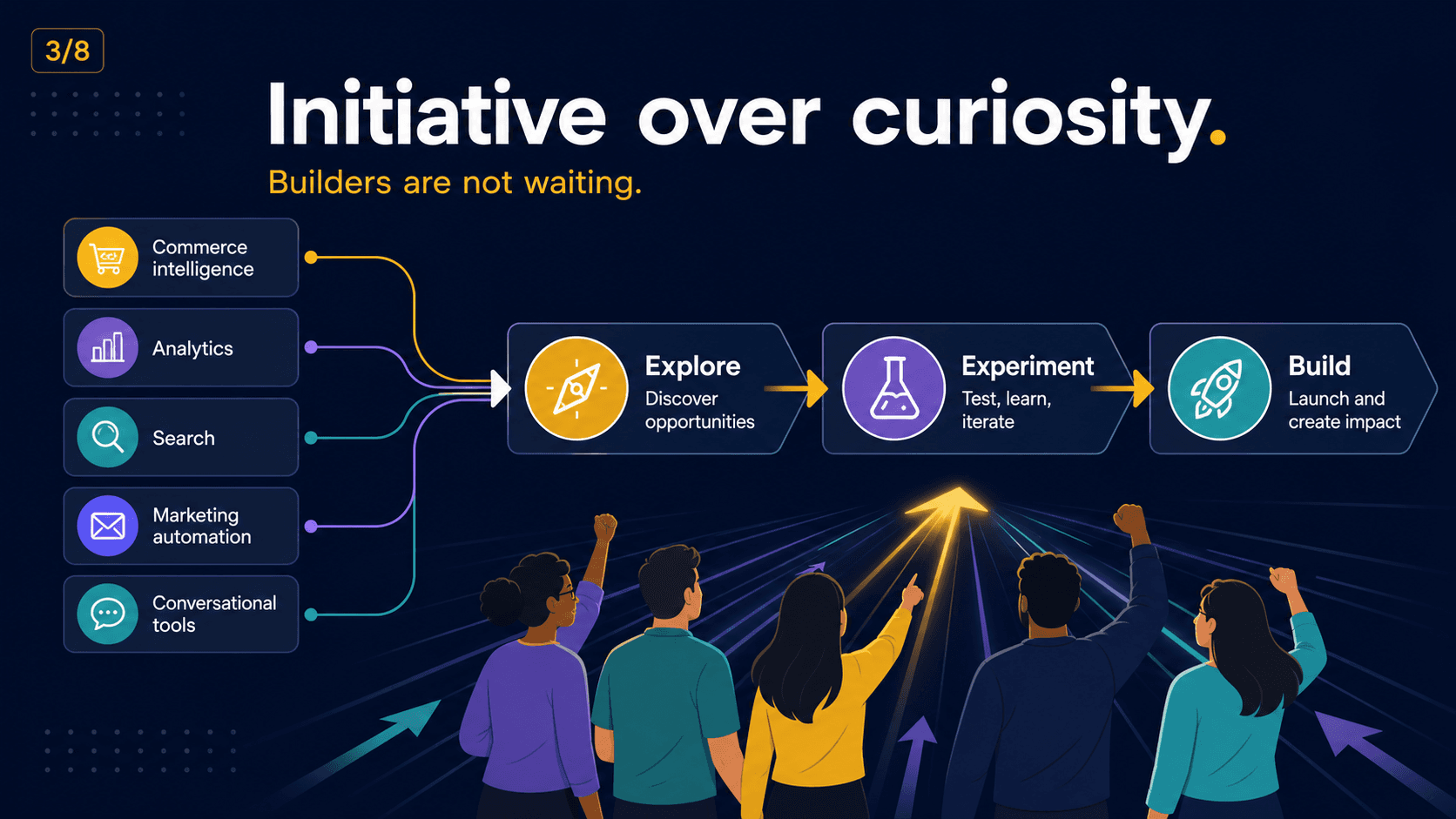
One of the clearest takeaways from the event was that people are not waiting for formal corporate programs to tell them when to start experimenting.
The builder energy was proactive. Participants showed up because they wanted to understand what becomes possible when commerce intelligence, marketing automation, analytics, search, and conversational capabilities are exposed as structured tools rather than confined to a user interface.
That is the deeper reason the audience composition matters. The market is not asking whether agents will exist. It is trying to figure out who will build them, what infrastructure they will rely on, and how quickly they can move from concept to execution.
What teams built mattered even more than who showed up
If the audience told one story, the submissions told another.
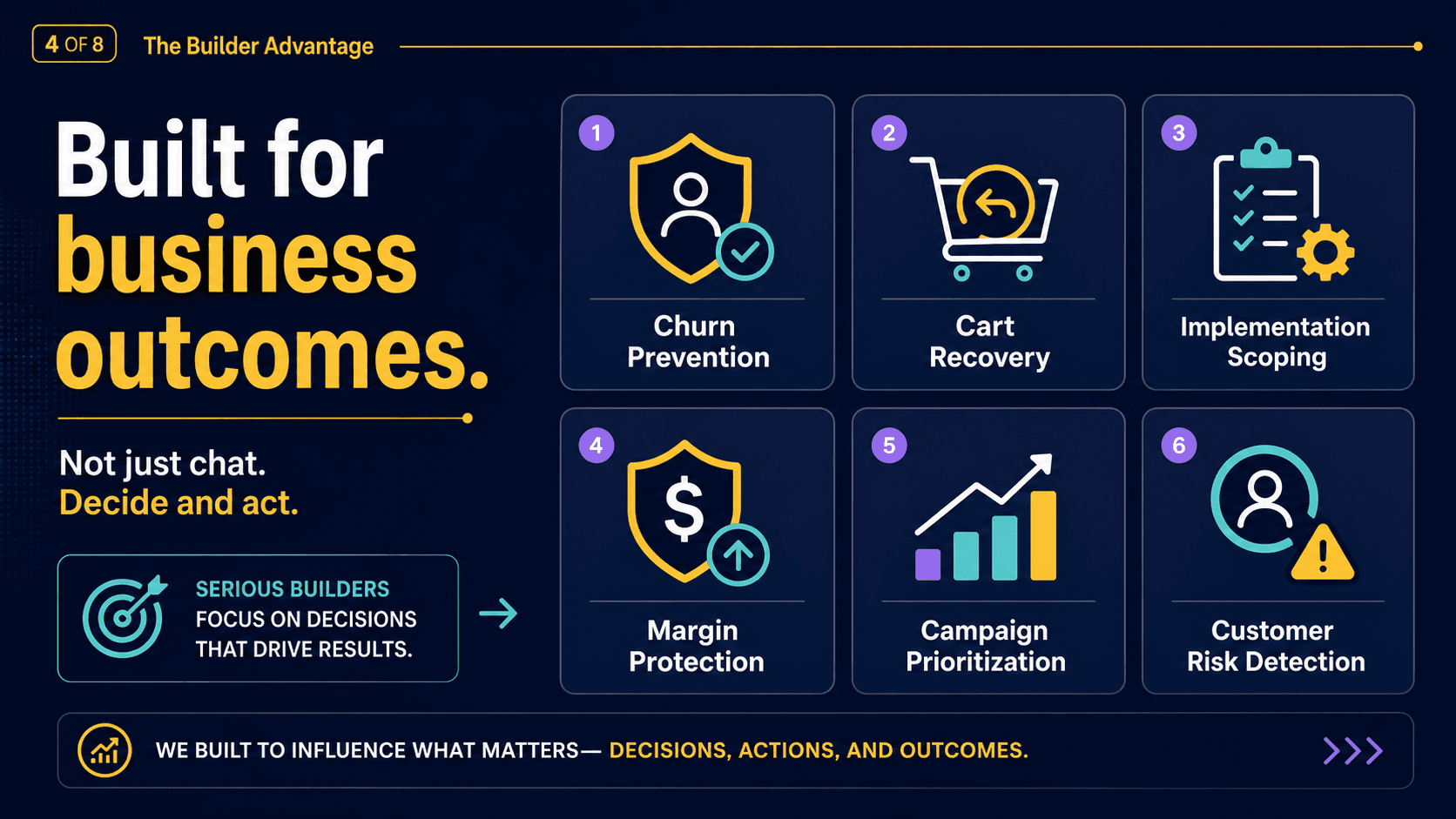
The strongest projects were not generic chat assistants. They were grounded in real business problems. Teams built agents around churn prevention, cart recovery, implementation scoping, margin protection, campaign prioritization, and proactive customer risk detection. In other words, they focused on work that operators already care about and outcomes businesses can immediately understand.
That pattern showed up again and again: the best entries were not trying to prove that an agent could talk. They were trying to prove that an agent could help a team decide and act.
What stood out to me most was how consistently teams pushed past surface-level interaction design and into workflow design. They were not just wrapping a language model in a chat box. They were trying to connect reasoning to operational leverage.
Orchestration mattered more than chat
One of the most encouraging patterns among the strongest teams was that they consistently thought beyond single-turn interaction.
The best agents connected multiple MCP surfaces, external systems, or both. They worked across workflows. They embedded themselves into environments teams already use, such as Bloomreach, Slack, or Notion. They turned business objectives into multi-step execution loops.
That distinction matters. A generic assistant can answer a question. A useful agent coordinates context, reasoning, approvals, and action across the systems where work already happens.
That is why so many of the best projects felt production-minded. They were not built as isolated demos. They were built as workflow companions, analytical copilots, or execution engines that could fit into the day-to-day reality of commerce and CRM teams.
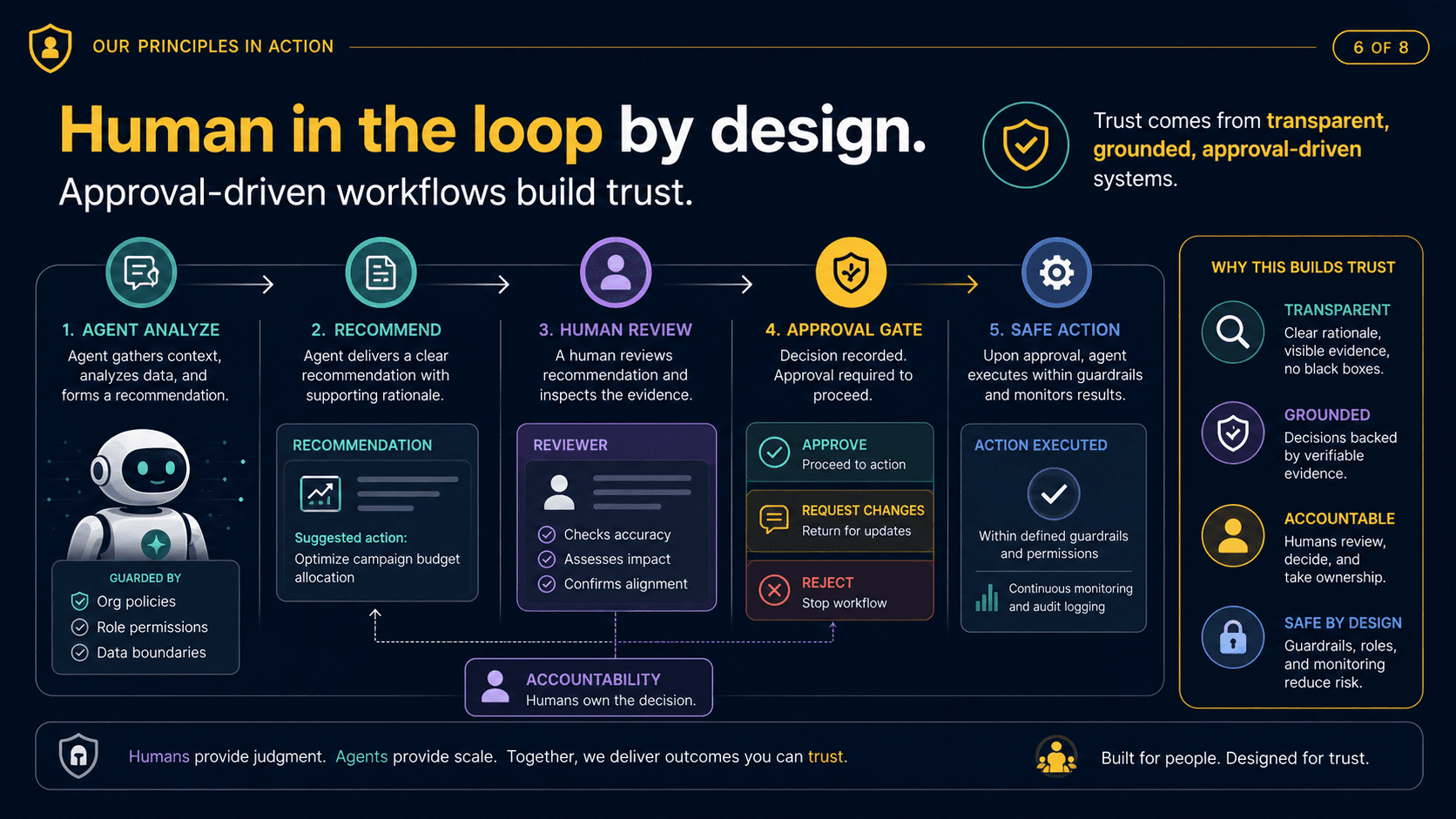
Human-in-the-loop was not a limitation. It was a design principle.
Another strong pattern was how naturally teams converged on approval-driven workflows.
This was one of the most important signals in the event. The strongest builders were not asking for reckless, unconstrained automation. They were designing systems that could reason deeply, surface evidence clearly, and then involve humans at the right decision points.
That is how serious businesses tend to adopt agentic systems. Trust does not come from removing humans entirely. It comes from giving teams agents that are transparent, grounded, and safe enough to participate in real workflows.
In that sense, the hackathon did not just reveal what people want agents to do. It also revealed how they want those agents to behave.
Analytics emerged as a core building block
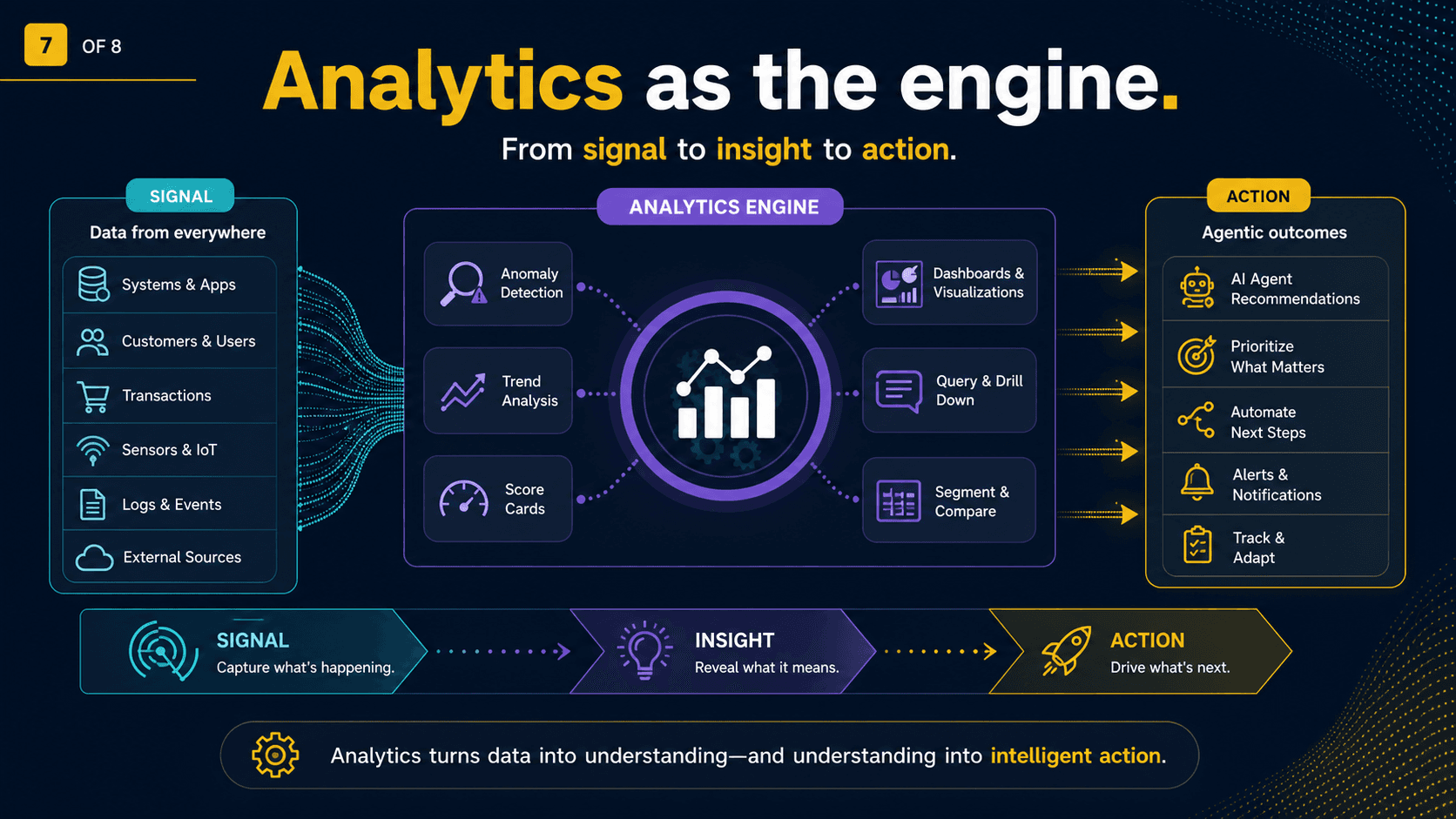
Another clear lesson was the central role analytics played in agent development.
Teams repeatedly leaned on analytics queries, anomaly detection, score-building, and workspace health checks. They were not using agentic AI just for retrieval or summarization. They were using it to interpret patterns, prioritize action, and close the gap between insight and execution.
That matters because it reflects a more mature view of what business agents should be. The goal is not to create a prettier dashboard or a more conversational reporting layer. The goal is to create systems that can understand performance signals, explain what changed, and help teams decide what to do next.
The top projects made the pattern tangible
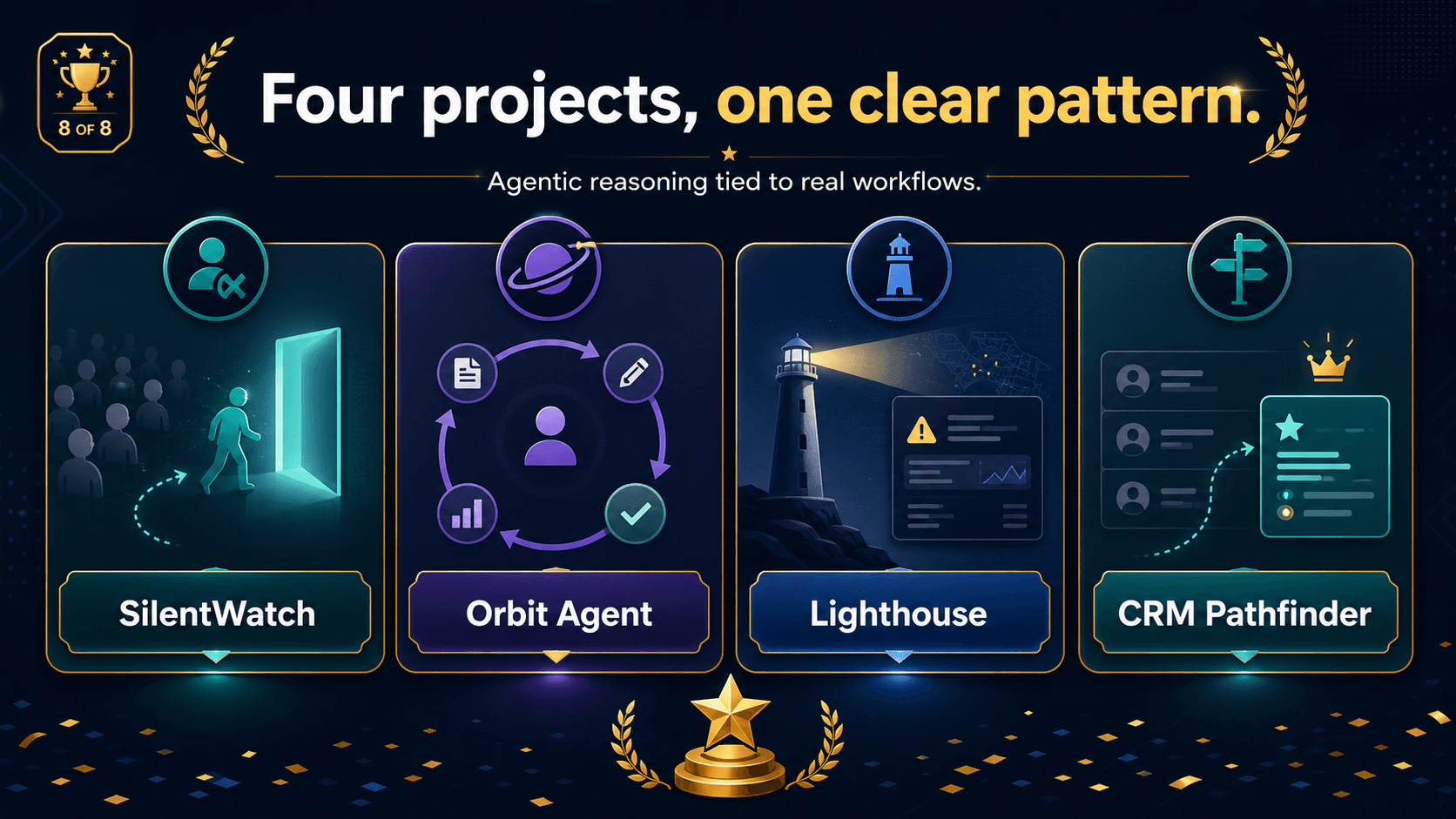
Some of the standout entries made these broader lessons easy to see.
SilentWatch, the winning project from Investown, focused on non-engaging customers. It identified who was disengaging, explored why, and helped CRM teams reactivate them more effectively. What made it compelling was not just the demo quality. It was the clarity of the use case. This was an agent a lifecycle marketer could understand immediately and imagine deploying in the real world.
Orbit Agent from Rohlik Group turned the marketer workflow — discover, build, send, measure, iterate — into a single loop with human approvals built in. It was a strong example of what production-grade agent architecture can look like when the goal is end-to-end operational value rather than a one-off interaction.
Lighthouse from ibxLab approached the problem from another angle. It acted like a customer experience risk officer, identifying trouble earlier and preparing a brief before lagging indicators like churn or campaign underperformance became obvious. Its ability to justify the risk signal was part of what made it interesting.
CRM Pathfinder from Vielendark tackled a question many CRM teams ask every day: what should we focus on next? Instead of creating another static dashboard, it inspected live campaigns, segments, and analytics to surface priorities and suggest next steps.
Different teams, different approaches, but a common theme ran through all of them: each project connected agentic reasoning to a meaningful business workflow.
What this suggests about the future of agentic commerce
Step back from the event, and a few conclusions become hard to ignore.
First, the audience for agent-building is already broader than many people expect. This is not just a developer story. It is also a commerce practitioner story, an agency story, a partner story, and increasingly a cross-industry story.
Second, the market is moving from fascination with AI agents as interfaces to demand for AI agents as infrastructure-backed systems. The strongest teams were not looking for a toy assistant. They wanted agents grounded in customer context, product intelligence, analytics, and execution surfaces.
Third, the winners are unlikely to be the teams that build the flashiest chat experience. They will be the teams that connect real business context to real decision-making and real workflows.
That is why this hackathon felt meaningful to me. It was not just a showcase. It was a live signal from the market.
It suggested that when builders get access to the right intelligence layer, they do not default to gimmicks. They build toward business outcomes.
And that, more than anything, is what makes this moment exciting.
The takeaway
The hackathon started with a simple question: if you open up a commerce intelligence layer to builders, what will they create?
The answer is much clearer now.
A surprisingly broad set of builders is ready to build agents. The best of them are focused on practical value, not novelty. They care about orchestration more than chat, approvals more than autonomy theater, and outcomes more than demos.
That feels like a strong signal not just for one company or one platform, but for the broader market. Agentic commerce is not arriving as a narrow technical trend. It is emerging as a new way to turn business context into action.
Based on what I saw, builders are more than ready to start.
Author bio
Andrew Kumar is Head of Loomi Connect at Bloomreach, where he focuses on how AI agents connect to commerce systems, marketing workflows, and analytics. His work sits at the intersection of product strategy, ecosystem development, and applied AI. He is also involved in the broader MACH Alliance agent ecosystem conversation; Bloomreach is an Agent Ecosystem sponsor, supports AI Exchange, and MACH Alliance was among the sponsors of the hackathon.
Bloomreach is the sponsor of MACH AI Exchange Hackathon.