
From Customer Questions to Product Confidence: Introducing the Product Insights Agent
May 27 2026 - By Alliance
By David Azoulay, Technical Consultant to the MACH Tech Office, MACH Alliance
Explore the reference implementation: Product Insights Agent GitHub repo
Product detail pages carry a lot of weight. They are where interest turns into intent, and intent either becomes a purchase or disappears into another tab.
But PDPs often fail at one critical job: answering the shopper’s actual questions.
Not the generic ones handled by bullets, specs, and badges. The real ones.
“Will this fit in my space?”
“Does this need special installation?”
“What does the manual say about maintenance?”
“Is this compatible with what I already have?”
For considered purchases, those questions matter. The more expensive, technical, regulated, configurable, or operationally complex the product is, the more likely a shopper is to pause before buying. Most brands already have the answers shoppers need in product catalogs, manuals, support articles, installation guides, warranty documents, and internal knowledge bases. The issue is access.
Traditional search helps when the shopper knows exactly what to search for. Live chat helps when someone is available. Static PDP content helps when the question is common enough to deserve page real estate. But when the answer is buried in a PDF, hidden in a spec sheet, or only available through support, customer hesitation can become abandonment.
That is the problem behind the first release from the Agent Solution Studio, a new program launched as part of the Agent Ecosystem initiative.
The Agent Solution Studio is producing a series of packaged agent prototypes. The goal is to move the conversation from “what could agents do?” to “let’s build one.” Each prototype is designed to be practical, extensible, and forkable, so members, ambassadors, and end users can run it, adapt it, and use it as a starting point for real implementations.
The Product Insights Agent, presented at MACH X: Toronto 2026, is the first in that series. It brings a product-aware agent directly into the PDP, retrieves the right information from trusted sources, answers routine questions instantly, and escalates the cases that deserve human attention. The prototype is intentionally narrow in scope, but complete enough to show how this pattern can work in production.
What we built
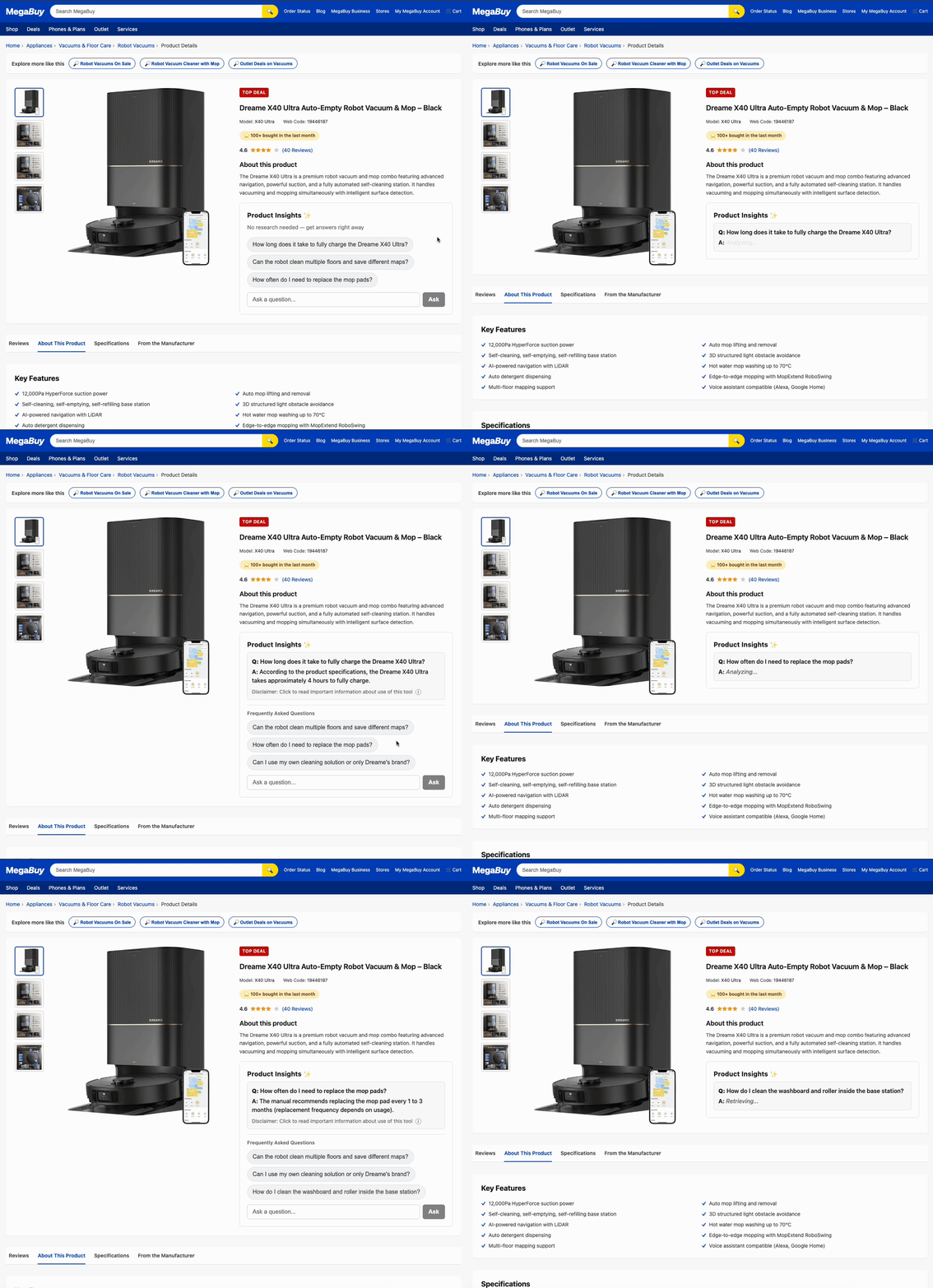
We built the Product Insights Agent, a PDP-embedded Q&A experience that helps shoppers get answers from trusted product information while they are evaluating a product.
On the frontend, the agent appears as an injectable widget that can be added to a product page with just one line of code. Vercel AI SDK structures the interaction and streams responses back to the shopper, so the experience feels responsive while the system retrieves context, applies guardrails, and generates an answer.
On the backend, the agent connects product catalog data with supporting product documentation, then uses that context to answer shopper questions. MongoDB Atlas powers vector search over processed product manuals, PDFs, support content, and other documentation, allowing the agent to retrieve the most relevant information at query time.
The system is built around a flexible product data adapter layer, so teams can connect it to a commerce engine, PIM, CMS, custom API, JSON source, or another product source of truth without tying the architecture to one platform.
Vercel AI Gateway is used to centralize model routing and AI provider access across tasks like classification, generation, and document processing. This gives the architecture a cleaner way to manage model usage without hardwiring the application to a single provider throughout the codebase.
We also instrumented LangSmith across the agent flow so teams can inspect what was retrieved, which guardrails fired, what the model saw, and why a response was produced. This makes the prototype easier to evaluate, debug, and adapt for production scenarios.
The reference implementation includes the core pieces needed to take the pattern beyond a demo:
- an embeddable PDP widget
- the agent backend
- guardrails for safer question handling and response generation
- a product data adapter layer
- a data ingestion pipeline for product documents
- vector search over processed product documentation
- centralized model routing and provider access
- observability for retrieval, guardrails, and responses
- a demo storefront
- a developer control panel
- documentation and production scaling guidance
How it works
A shopper starts with a question on the PDP. Before the system generates an answer, the request moves through a layered flow designed to keep the response safe and relevant.
The first step is a pattern guard. This checks for obvious unsafe inputs, prompt injection attempts, and malformed requests before they reach the model. If the input fails this layer, the request is blocked early instead of spending model tokens or risking an unreliable response.
From there, several steps run in parallel. The system classifies the question to determine whether it is product-related or whether it should be handled by a human, such as questions involving sensitive topics, legal issues, support escalation, or anything outside the agent’s intended scope. At the same time, it retrieves structured product information, such as attributes, dimensions, and features, through the product specs adapter. It also retrieves unstructured product content, such as manuals, support documents, and product PDFs that have been processed into searchable chunks.
Those retrieved materials become the context for the answer. The model generates a response using only the structured product data and retrieved documentation. If the answer is not supported by the available context, the agent avoids speculation and directs the shopper toward another path, such as human support.
After generation, the response goes through a post-check layer for additional validation, such as unsupported claims, unsafe content, or other response issues. The full path is traced for later inspection and debugging.
The ingestion pipeline makes the unstructured side possible. Product documents are converted into structured text, chunked, enriched, embedded, and stored in a vector search layer for retrieval at query time.
One important part of the pipeline is the 3x3 grid sweep, which automatically tests different chunking configurations for product PDFs and manuals. It evaluates nine combinations of chunk size and overlap against product Q&A examples, then produces a scorecard to identify the best configuration for retrieval quality.
Once a configuration is selected, the pipeline uses it consistently for product document ingestion. It also generates suggested starter questions from the product content and validates them against the live index, so the questions shown on the PDP are tied to information the agent can actually retrieve and answer from.
Why it matters
Agents are most useful when they are placed inside a real workflow, connected to real systems, and given a clear job. In this case, the job is simple: help a shopper make a product decision with confidence.
That is why this was the right first prototype for the Agent Solution Studio. It addresses a recognizable business problem, uses information brands already have, exercises multiple parts of a MACH stack, and creates an experience that is easy to understand the moment you try it.
Future prototypes in the series will explore other patterns, including B2B order intake, content enrichment, fulfillment orchestration, returns triage, and service agents with scoped order actions.
The Product Insights Agent starts with one moment in the customer journey: the unanswered question on the PDP. But the broader idea is bigger. When agents are grounded, observable, and composed into the right workflows, they can turn existing business knowledge into useful action.
Explore the reference implementation on GitHub: machalliance/solution-studio-product-questions
David Azoulay is Director of Agentic Systems Engineering at Orium, and Technical Consultant to the MACH Tech Office at MACH Alliance. Learn more about the agent ecosystem vision at agentecosystem.org