Upgrading Without Starting Over: A Smarter Approach to Modernizing Tech
Apr 8 2025 - By Alliance
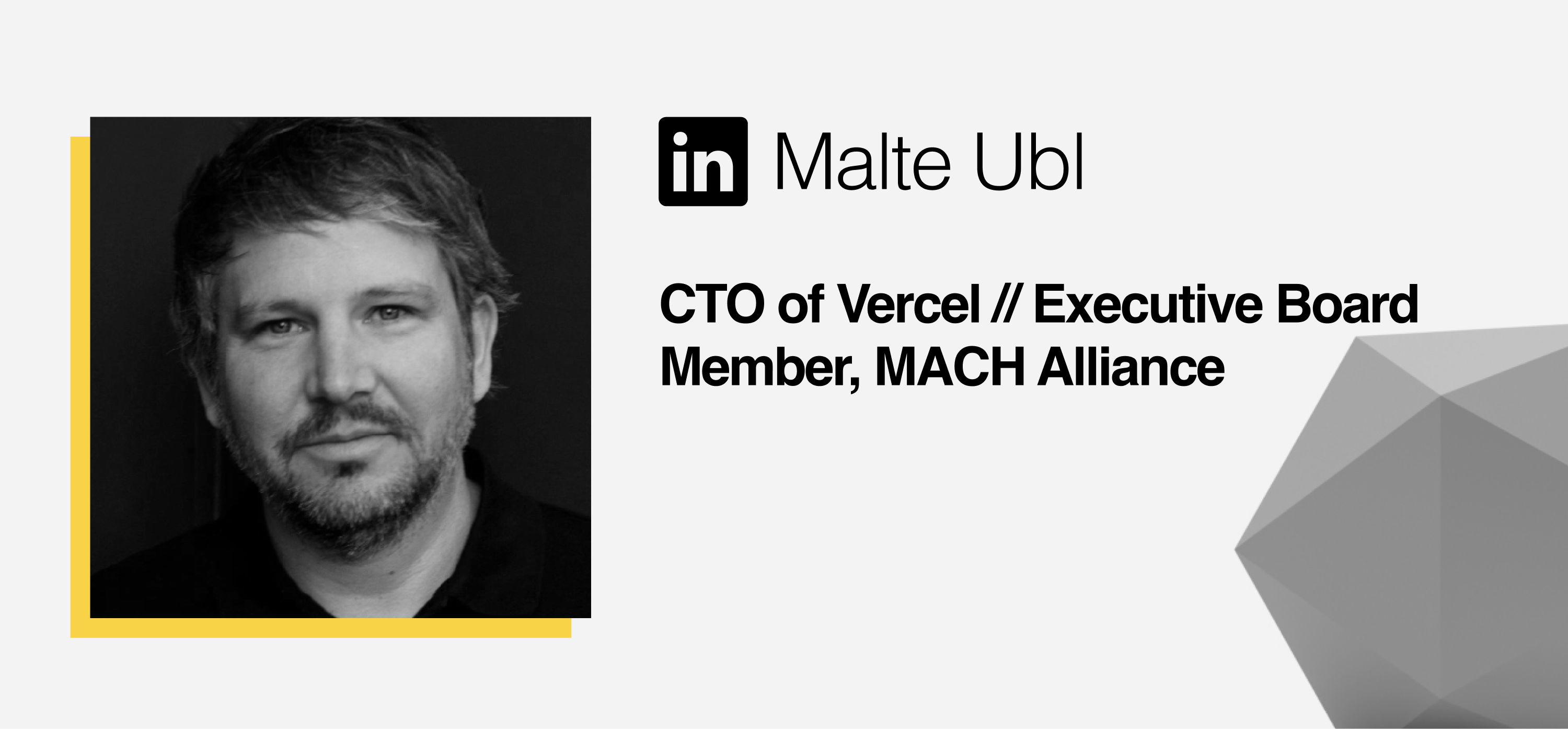
Author: Malte Ubl, CTO of Vercel and MACH Alliance Board Member
Smarter modernization
Today's businesses face a challenging reality: they need to innovate rapidly to meet evolving customer expectations, but can't afford the disruption and risk of replacing their entire technology stack at once. Many are operating with systems that have served them well for years, sometimes decades.
This false dichotomy has no place in transformation discussions. Two common choices are to continue with increasingly limiting legacy systems or undertake a risky “big bang” replacement." Neither option is ideal, and both ignore a fundamental truth about successful digital transformation: it's not about starting over, but about creating a technology foundation that can evolve with your business.
Evolution, not revolution
Since 2020, when the MACH Alliance formed, we've witnessed a significant shift in how organizations approach modernization. What was once a disruptive acronym (Microservices, APIs, Composable, Headless) has now evolved into a set of principles for an industry: Composable. Open. Connected. Incremental. Autonomous. This is the guiding framework, spanning both architecture and mindset, that supports brands and businesses in their journey to digital freedom. The most successful implementations share a common characteristic: they're pragmatic, focused on tangible outcomes rather than technical purity.
The biggest myth in modernization is that you need to replace everything at once. This all-or-nothing perspective creates unnecessary risk, expense, and organizational resistance. Instead, forward-thinking companies are taking a more nuanced approach, focusing on flexibility between existing systems and new capabilities, prioritizing changes that deliver immediate value.
The bridge to value creation
The ability for systems to connect, communicate, and work together—is the unsung hero of successful digital transformation. It embodies the "Connected" and "Open" principles that are foundational to effective modernization strategies. By focusing on interoperability, organizations can create a path to modernization that:
- Optimizes valuable legacy investments while gradually introducing modern capabilities
- Reduces risk by allowing incremental changes with measurable outcomes
- Accelerates time-to-value by enabling innovation in high-impact areas first
- Minimizes disruption to existing operations and customer experiences
- Delivers tangible ROI at each stage of the transformation journey
Consider a company with a monolithic ecommerce platform that has served them well, but struggles with frontend flexibility. Rather than migrating the entire platform–a costly, high-risk endeavor–they could implement a headless approach that leverages their existing backend as an API. This delivers immediate business value through improved customer experiences, while establishing a foundation for future backend modernization when it makes business sense.
The practice path forward: Incremental and autonomous
Successful modernization requires smart, strategic choices that drive meaningful outcomes. The "Incremental" and "Autonomous" principles of modern architecture guide us toward an approach that emphasizes continuous delivery, experimentation, and the ability to adapt quickly to changing requirements guide architecture decisions. Here's what that looks like in practice:
Start with outcomes, not technology
- Define clear priorities and specific results you aim to achieve
- Identify which capabilities will deliver the most impact with the least disruption
- Focus on solving actual problems rather than implementing technical trends
Design for evolutionary change
- Create clear interfaces and boundaries between systems
- Implement flexible orchestration that enables systems to work in harmony
- Prioritize real-time connectivity over duplicating data across systems
- Build composable elements where they deliver clear advantages: frontend experiences, high-change capabilities, and specialized functionality
Establish thoughtful governance
- Create architectural guidelines that balance flexibility with control
- Implement standards for APIs, data models, and integrations
- Design an architecture where components can be replaced without disrupting the whole system
Impact: What matters most
The true measure of successful modernization is tangible impact. Companies that take a pragmatic, ROI focused approach see meaningful benefits:
- Accelerated innovation cycles as teams can update specific capabilities without coordinating massive releases
- Improved customer experiences through more responsive, personalized digital touchpoints
- Greater adaptability to changing market conditions and competitive threats
- Reduced technical debt as legacy systems are gradually modernized
- Better utilization of technology investments across both legacy and modern systems
We've seen retailers significantly accelerate their time-to-market for new features by implementing headless approaches while maintaining their existing backend systems. Similarly, manufacturing companies have substantially reduced integration costs by standardizing their API across legacy and modern systems.
Planning your journey: Composable by design
Every organization's modernization journey will be unique, based on their starting point, priorities, and resources. The "Composable" principle reminds us that systems should be modular and flexible allow organizations to achieve their digital strategy while remaining resilient to change. Successful approaches share common elements:
- Honest assessment: Understand your current technology landscape, including strengths and limitations
- Clear vision: Define what success looks like in concrete terms, not just technical architecture
- Prioritized roadmap: Sequence changes to deliver value at each step
- Interoperability focus: Design with connectivity and integration as primary considerations
- Meaningful metrics: Establish clear KPIs tied to goals, not just technical milestones
- Continuous learning: Embrace feedback loops that allow for course correction based on real results
POV: Outcomes, No Dogma’s
Digital transformation isn't a one-time project, it's an ongoing process of evolution. By approaching modernization with value creation and interoperability at the center, companies can create technology ecosystems that deliver results today while future proofing their business change.
Architecture should never be pursued for its own sake. It's a means to an end, the end being better outcomes, improved customer experiences, and greater organizational agility. When we lose sight of this fundamental truth, we risk creating technically impressive systems that fail to deliver real value.
Author: